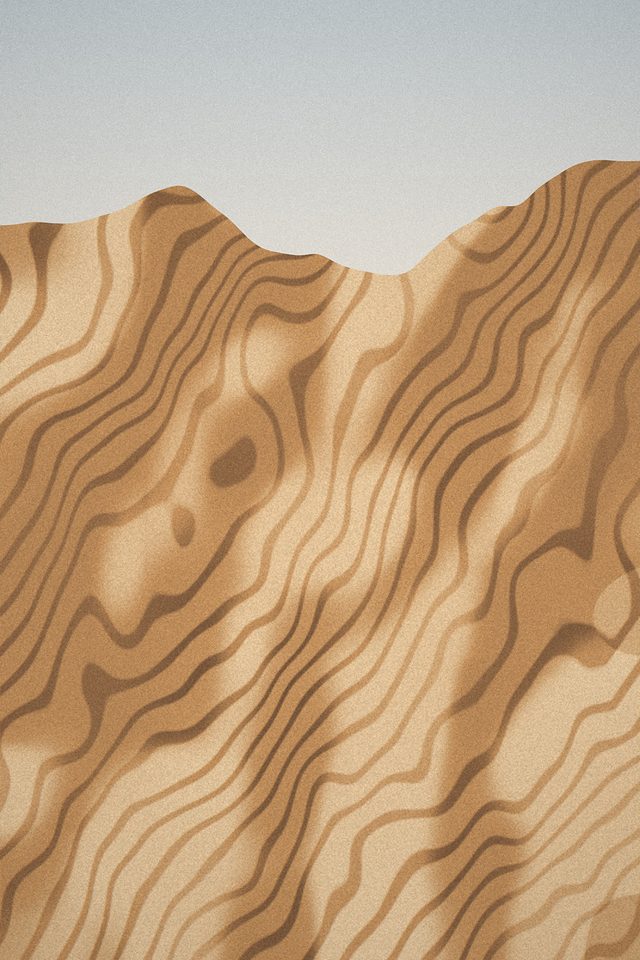
Ripples in sand are one of the few subjects I know that look the same at every size. A field of ripples photographed from a metre away and a field of dunes photographed from a plane share the same grammar: long repeating lines, a gentle slope on one side, a steep shadowed face on the other, and occasional places where the pattern splits or bends.
That is what attracted me to them. It also became the main problem of the series.
Losing the scale
The first round of pictures I made for Dune Grammar were close, overhead views with no horizon and no reference. On the screen they looked striking. On the wall, people stood in front of them and asked what they were. Some guessed aerial views of deserts, some guessed wood grain, one person was sure they were looking at a close-up of fabric.
I liked that ambiguity for a while. But a series of twelve pictures that all ask the same question wears thin, and by the fourth or fifth frame the guessing becomes the only experience. The pictures needed something that would let a viewer find their footing, at least occasionally.
Small anchors
I tried a few approaches before settling on the ones in the series:
- A crest and a sky. A few frames include the top of a dune and the pale sky behind it. Once you see one of these, the close-ups that follow read as sand.
- Light direction. A low sun throws long shadows, and long shadows imply distance. Pictures made in flat light were the hardest to read and most of them were cut.
- Imperfection. The places where the ripples break — around a slight hollow, where the wind changed direction — give the eye something particular to hold, which makes the pattern feel real rather than generated.

Working in the field
The practical difficulties were mostly about footprints. Ripples are destroyed by a single step, so every approach had to be planned: walk along the lee side, never across the face you want to photograph, and work from the outside of a patch inward. On a good afternoon I would find a patch, circle it slowly, and photograph it from two or three positions before moving on.
Wind is the other variable. A strong wind rebuilds the ripples in hours, which is a gift — the same patch can be photographed again the next day and look completely different. A light wind leaves them unchanged for days, which is useful when you want to come back at a different time of day for different light.
Light and colour
Most of the series was made in the last two hours before sunset, when the sand turns amber and the shadows lengthen. A few frames came from midday, bleached and pale, and one session from an overcast afternoon, almost grey. I kept those for contrast: they remind the viewer that the warmth isn’t the sand’s colour, it’s the hour’s.
Letting it be abstract
In the end I kept the series mostly abstract. The anchors are there, a few of them, but the majority of the frames still ask the viewer to decide what they are looking at. I think that is fair. The wind doesn’t care about scale either, and the pictures are as much about the pattern as about the place.