I booked the week months ahead on the strength of an old memory: a hard blue sky over white ridges, the kind of day where you can see sixty kilometres. What I got was an inversion. For six of the seven days, the valley sat under a grey lid of cloud, and the ridges above it appeared and disappeared like islands.
This is a short account of that week, partly as a record and partly because the pictures in Snowline make more sense with it.
Day one and two: waiting
The first two days were spent mostly inside the cloud. From the village there was nothing to see, and the forecast promised clearing “later”. I walked up the nearest path each morning to check, came back down, and spent the afternoons reading and cleaning gear that didn’t need it.
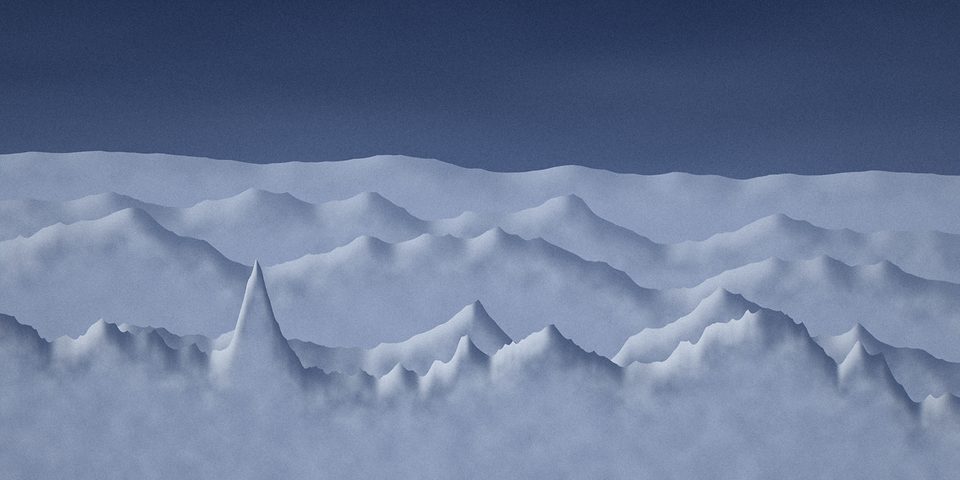
On the second evening I walked further, about an hour of climbing, and came out above the cloud just after sunset. The valley was a flat white sea. Above it, ridge after ridge stood in the blue light, each a slightly lighter shade than the one in front. I had no tripod and only the short lens, and the light lasted ten minutes. But I knew then what the week was going to be about.
Day three to five: the layers
For the next three days I went back to that height every morning and evening, carrying the long lens and a light tripod. The inversion layer sat at almost the same altitude each day, so the view was consistent in a way that a clear sky never is: the fog did the same job every time, separating the mountains into planes.
A few things I learned quickly:
- A longer lens compresses the ridges and makes the layers read as stacked; a wide lens spreads them out and loses the effect.
- Exposure has to be generous. The meter sees all that white and underexposes it to grey; I was adding between one and almost two stops.
- The blue of the shadows changes fast after sunset. I made frames every few minutes and later chose the ones where the blue was still soft.
Cold was the main practical problem. At minus twelve, batteries lasted about a third of their usual time, and I kept spares in an inside pocket. The tripod legs froze stiff on the fourth morning and had to be warmed by hand before they would extend.
Day six: clear
On the sixth day the inversion lifted and I finally got the sky I had come for. I made a lot of pictures that day and almost none of them are in the series. The clear light flattened the ridges into a single, sharply detailed wall, beautiful in its way but without the depth the fog had given. Two frames made it in, mostly for contrast with the rest.
Day seven: going home
The last morning was whiteout: no ridges, no valley, just a pale gradient where the mountains should have been. I made a few frames anyway, more as a record than anything. One of them, almost entirely white, has ended up as the quietest picture in the series.
Update, February 2026: I have added two frames from the second evening that I had initially left out, after printing a test sequence and finding the series needed a darker picture near the start. The text above is otherwise unchanged.