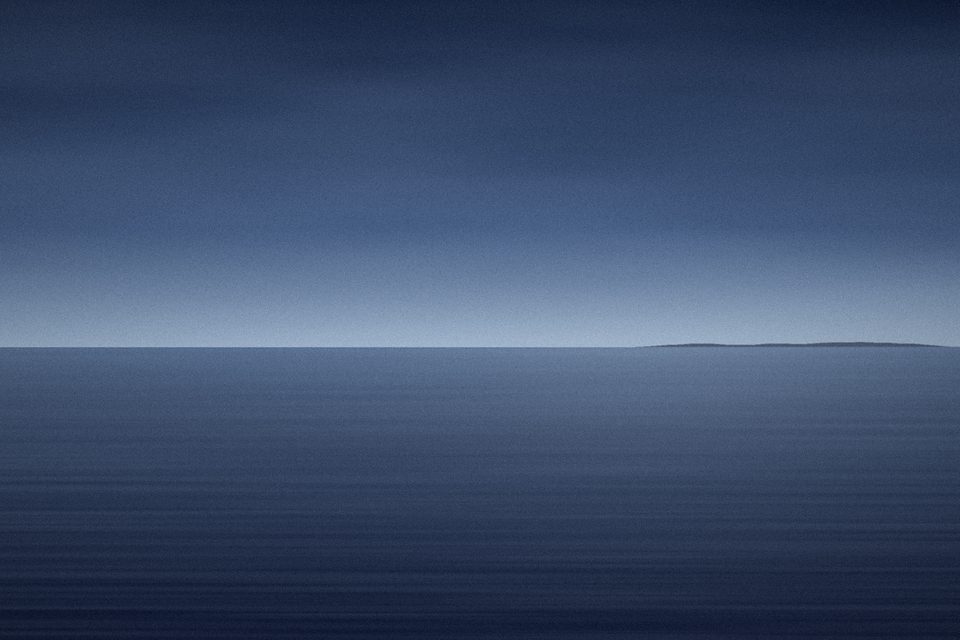
For a long time I treated overcast mornings as days off. The forecast would show a grey blanket over the coast and I would stay in, answer email, sort files, tell myself I would go when there was a sunrise worth getting up for. It took me an embarrassingly long time to notice that the pictures I kept returning to, years later, were almost never the ones with a sunrise in them.
Flat light gets a bad reputation because it is unforgiving in the wrong places. Point a camera at a street on a grey day and everything is the same brightness: no shadows to give shape, no highlights to lead the eye. But point it at open water and a sky with nothing in it, and the same lack of contrast turns into something else. The tones are close together, so small differences start to matter. A slightly brighter band near the horizon becomes the subject. A faint warm patch in the water, the last trace of a sun you can’t see, becomes the whole picture.
What changes when the light goes flat
The most practical difference is time. On a clear morning the good light lasts perhaps twenty minutes; after that the sun is up, the contrast is too high, and the sea starts throwing sparkles that look wrong in a long exposure. On a grey morning the light changes slowly, sometimes over an hour, which means I can make a frame, look at it properly, adjust, and make another. Low Water was built on that kind of morning: four or five exposures of a few minutes each, a lot of standing still, and very little rushing.
The second difference is how much the exposure itself matters. With so little contrast in the scene, there is no “correct” exposure in the meter’s sense. Exposing for a brighter, airier result gives one picture; exposing a stop darker gives a heavier, more silver one. Neither is wrong. I started deciding before I left the house which of the two I wanted that day, and it made the editing afterwards much easier.
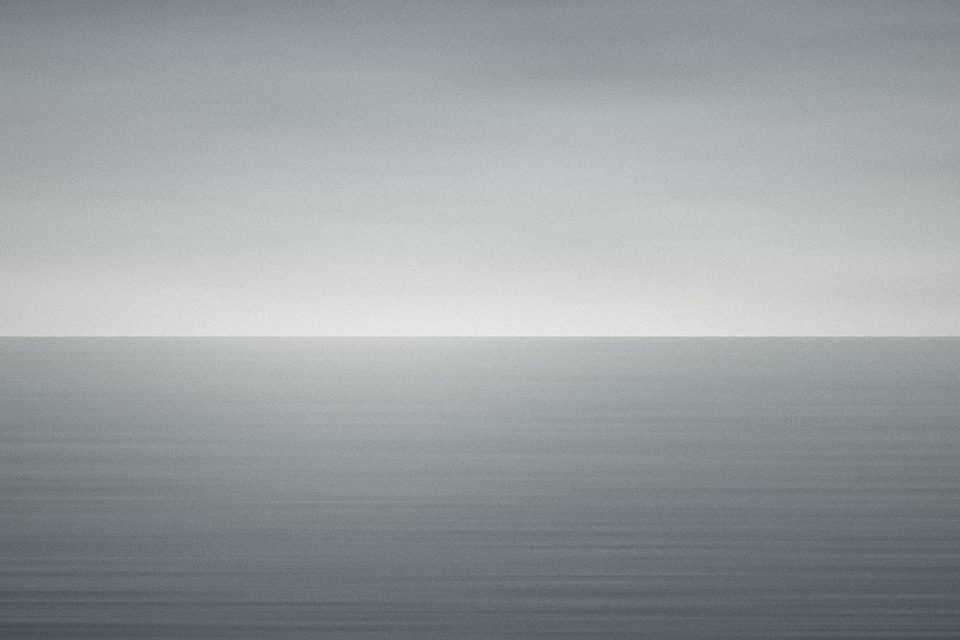
Reading a grey sky
Not all overcast is equal. The skies I look for have a little structure — a thinner patch of cloud where the sun is, or a slight banding left over from the wind. Completely uniform cloud gives a picture with nothing to hold on to. Broken cloud gives too much. The useful middle is often visible only for a few minutes, and from the shore rather than from a window, which is why I mostly go anyway and decide on the spot.
A few habits that have helped:
- Arrive early enough to watch the sky change before deciding where to stand.
- Keep the horizon level with a bubble level, not by eye; with nothing else in the frame, a tilt is the first thing anyone sees.
- Make one frame at the end with the exposure halved. It is often the one I keep.
- Write down the time and the exposure. The files carry the numbers, but not what it felt like.
The temptation to fix it
The hardest part of working in flat light is not the shooting but the editing. Every slider on the screen is an invitation to add the contrast the morning didn’t have. A little clarity, a slightly deeper blue, a gradient to darken the sky — each of them makes a single frame look more finished, and each of them makes the series look less like the place.
If the light was flat, the picture is flat. That is the deal.
I now do almost everything at capture: the exposure, the position of the horizon, how long the shutter stays open. Afterwards I adjust white balance and overall brightness and leave it there. When I print these, they read as quiet and a little cool, which is exactly what those mornings were.
I still go out for sunrises sometimes. But I have stopped staying home on grey days, and the coast has been much more generous since.